How Many Koi Should Be in Your Fish Pond?
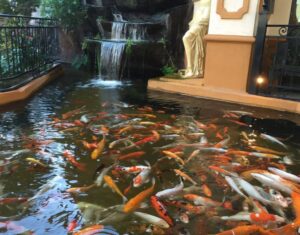
Koi stocking plays a critical role in koi health, water quality, and long-term pond success. Many pond problems begin when too many koi are added without considering pond size, surface area, filtration, and future growth. Koi grow quickly, produce large amounts of waste, and place heavy demands on filtration systems. Pond owners must plan stocking levels carefully to avoid stress, disease, and water quality failure.
Koi stocking: How to Calculate the Correct Number of Koi
To determine how many koi your pond can support, you must first measure the pond’s surface area. Calculate this by multiplying the length by the width. For example, a pond that measures 3 meters wide and 6 meters long has a surface area of 18 square meters.
When introducing fish into a new pond, you should allow a maximum of 25 cm of fish per square meter of surface area. This conservative approach gives the pond time to establish beneficial bacteria and stabilize water quality. Once the pond matures—usually after about three years—you can gradually increase the stocking level to 50 cm (or 2 inches) of fish per square meter. Never add large numbers of fish at the same time, and always plan for their adult size.
Proper koi stocking depends on excellent water quality. Your pond should maintain very low ammonia levels and use efficient mechanical and biological filtration supported by UV lights. In South Africa’s warmer climate, higher temperatures increase waste production and reduce oxygen levels, so you should always double the recommended filtration and equipment capacity compared to European guidelines.
Some sources suggest one koi per 1,000 liters, while others recommend one koi per 2,000 liters. The safer option is one koi per 2,000 liters. Overstocked ponds quickly become unstable. A 15,000-liter pond with thirty koi is a disaster waiting to happen. Such a pond should house no more than seven large koi. Even with daily water changes, the water often remains dirty, smelly, and unhealthy, and the koi suffer.
Many first-time koi keepers make the mistake of buying too many small koi without considering growth. Within months, the pond becomes overstocked. Responsible koi stocking protects your koi, your equipment, and your investment for the long term.